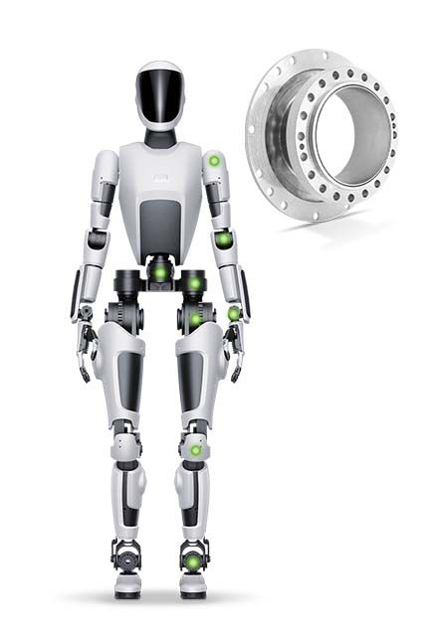
The rapid development of humanoid robots is opening up exciting opportunities for the gear manufacturing industry. As robots become increasingly capable of performing complex, human-like movements, the demand for compact, lightweight and highly accurate gearing is growing.
In an article published by Gear Technology on October 23, 2026, the authors Dipl.-Ing. Markus Krömer, Klaus Deininger, Gottfried Klein and Dr. rer. nat. Stefan Beermann examine the important role of strain wave gears in making these advances possible.
Strain wave gears, also known as harmonic drives, are particularly suited to robotic applications because they offer high reduction ratios in a relatively small package. Their zero-backlash characteristics, high torque capacity and positional accuracy make them ideal for the shoulder, wrist, knee and ankle joints of humanoid robots, where smooth and reliable movement is essential.
However, manufacturing these specialised gears presents considerable challenges. Their extremely small modules, high tooth counts and demanding accuracy requirements call for advanced machining and inspection techniques.
The article highlights how modern manufacturing processes such as power skiving and hobbing can deliver the necessary precision and productivity. One example involved producing a 320-tooth internal gear, achieving an impressive machining cycle time of just 0.7 minutes while meeting exceptionally tight quality tolerances.
Inspection is equally important. Advanced metrology systems are required to measure these small, intricate components accurately, ensuring consistency and reliability throughout production.
As humanoid robotics continues to evolve, the ability to manufacture increasingly sophisticated precision gears will become ever more important. For the gear industry, this represents an exciting opportunity to apply advanced engineering and manufacturing technology to a rapidly emerging market. The article explains the more technical aspects of this process.