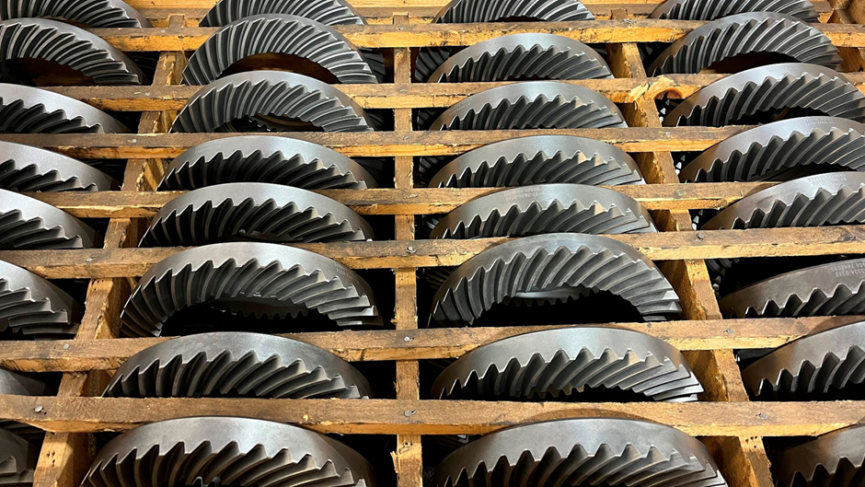
It’s been a while since we featured an extract from Dr.Hermann J. Stadtfeld in these pages. What follows is a preview of an extract from ‘The Gleason Works’ 2025 by this author and featured in Gear Technology magazine. Basically, this is a precis of a precis!
The article explains when you can swap one gear for another—and why it’s often more difficult than it seems.
At a basic level, gears work in pairs, and both parts must match very closely in shape and size for smooth operation.
In simpler systems—like couplings, clutches, or certain straight bevel gears—you can sometimes replace one gear without changing the other. These designs are more standardised and less sensitive to small differences.
More complex gears, especially spiral bevel gears, are usually custom-made as a matched pair. To replace just one gear, many details must line up precisely, such as tooth shape, angles, and how the gear was manufactured.
Even if two gears look alike, they may not work together if they were made using different processes such as one produced by face hobbing and the other by face milling.
Face hobbing is a manufacturing method used to cut gear teeth. Imagine a rotating cutting tool gradually shaping the teeth as the gear blank spins. It’s designed for efficient production, but it produces a slightly different tooth form compared to other methods (like face milling). Because of these subtle differences, gears made with face hobbing usually won’t mesh properly with gears made by other methods.
Why matching matters:-
Gears are designed to work as a pair. If one is replaced with a non-matching gear:
• the teeth may not contact properly
• the load may not spread evenly
• this can lead to noise, faster wear, or even failure
So, what’s the solution?
If a replacement is needed and no exact match exists, engineers often measure the original gear—or its partner—and recreate a matching gear using specialised tools or software.
While some simpler gears can be swapped, most precision gears must be treated as a matched set.
Replacing just one without ensuring compatibility can cause serious problems. For more detail refer to the article here.